
How Emollient Structure Affects Texture, Slip, and After-Feel in Formulations
Between the sheer number of options and what often feels like no information from the supplier, I find the emollient selection to be quite challenging.
Sometimes I find myself just reaching for my trusty cap/cap trig without thinking it through. Just like reaching for sweatpants on a Sunday.
Comfortable? Yes. Always the right choice? Probably not.
And if you are anything like me, it is time to gain a deeper understanding of how to make better selections within this broad class of materials.
While they certainly don't act alone, emollients play a big role in the following…
Overall texture of an emulsion
Spreadability and initial slip
Rub out, absorption and end feel
Structure of the emulsion
Emulsion droplet size
Release of lipophilic actives
Understanding Emollient Families and Structure
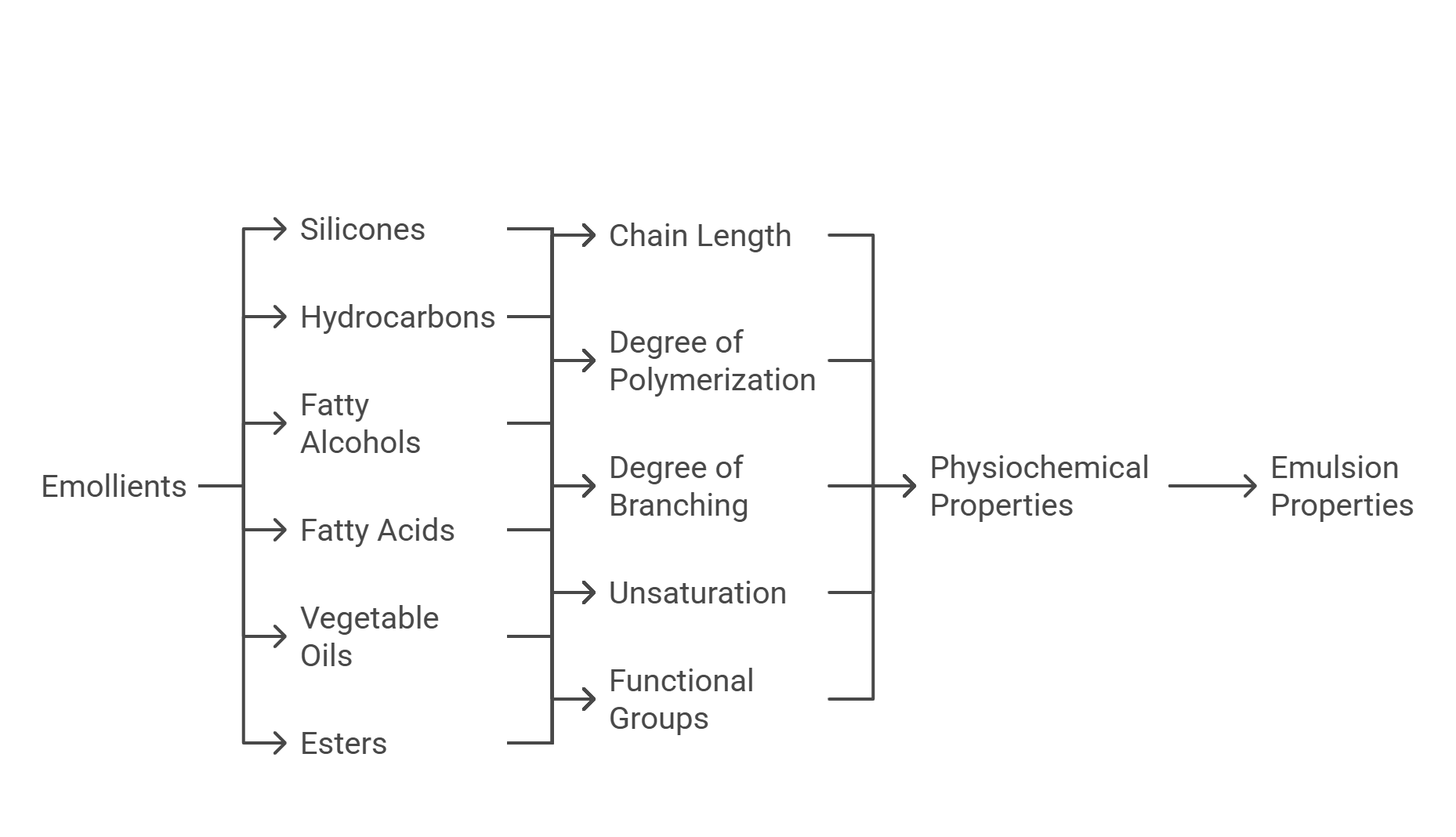
Emollients can be broadly categorized into silicones, hydrocarbons, fatty alcohols, fatty acids, vegetable oils and esters.
Within any individual emollient family, you can have a wide variation in chemical structure such as the chain length, the degree of polymerization, the presence/degree of branching, the unsaturation and the presence or absence of functional groups. These structure differences can affect the physiochemical properties of the emollients and ultimately the emulsion itself.
To help guide your selection, we first need to understand how these structural features influence the key properties that matter during and after application. Spoiler alert: it all basically comes down to how well (or poorly) molecules play together.
How Chemical Structure Affects Viscosity
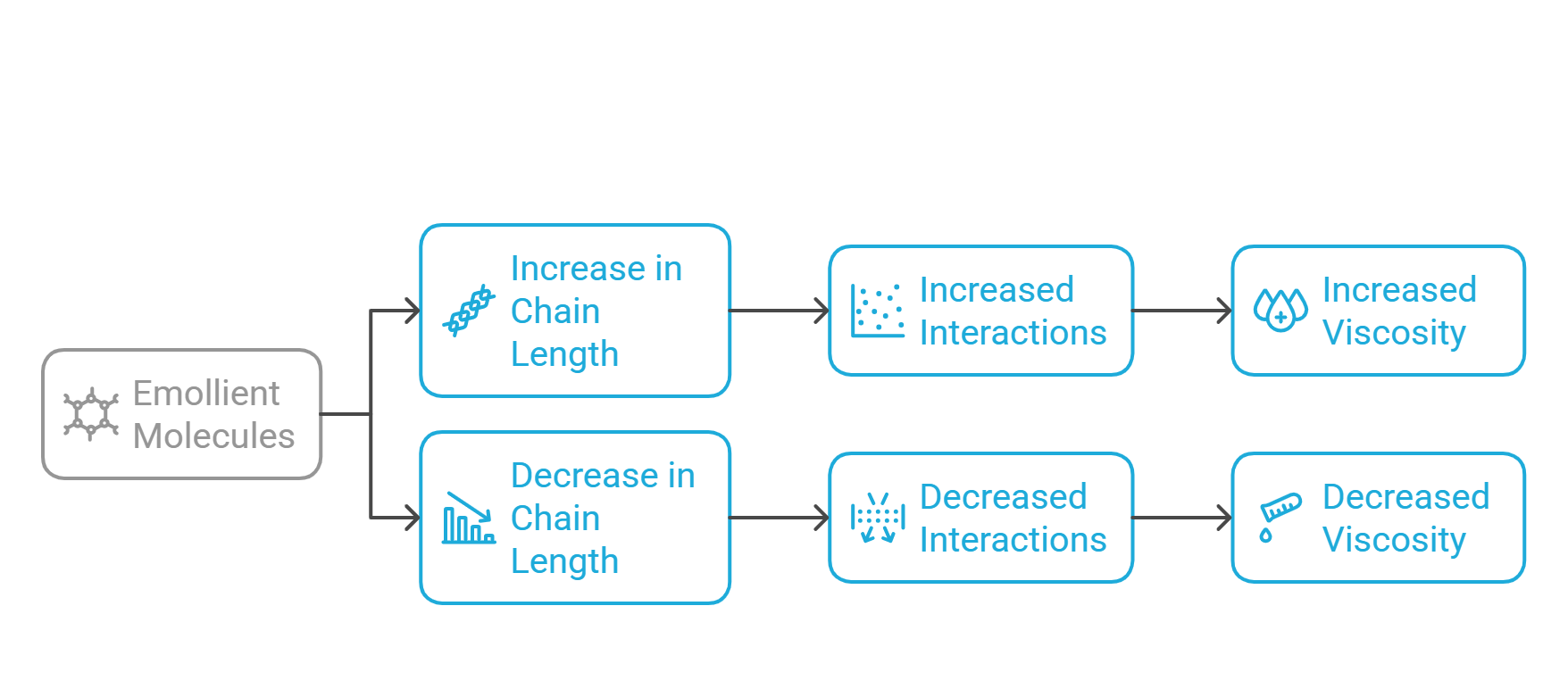
As a general rule of thumb, an increase in the chain length within a family of emollients will typically increase the viscosity, due to the increase in interactions that those molecules can have. Think of it like a pot of cooked spaghetti vs. a pot of orzo. Those long spaghetti strands interact with each other creating tons of contact points. Try stirring it and there is resistance! Meanwhile, the shorter orzo pieces just tumble around each other more freely. The emollient molecules can behave similarly.
The introduction of unsaturation and branching to a family of emollients typically decreases the viscosity. This is because it makes it harder for the molecules to pack closely together reducing intermolecular interactions. Certain functional groups, like those that contribute to hydrogen bonding, typically increase viscosity. This is because the stronger the intermolecular forces are, the greater the resistance to flow.
So, in general, the more intermolecular interactions and forces there are at play between the molecules, the higher the viscosity is likely to be.
Understanding this helps us predict and control critical sensory attributes like spreadability.
Spreadability: Getting the Product Where You Want It
When thinking through your emollient selection, you first need to consider how easily the product should spread. For example, a body lotion is going to need to spread way more easily than say a hand cream.
As you start to apply a product onto the skin there will be an initial wetting of the surface followed by vertical penetration and lateral migration. Many researchers have demonstrated that this process is impacted the most by both the viscosity and the surface tension of the emollient {1, 2, 5].
For example, one study showed that the studied alkane, which had a high interfacial tension with the skin, showed poorer spreading which led them to the conclusion that emollients with higher surface tension are more difficult to spread [2].
However, M. Douguet, et al, demonstrated that viscosity likely has a higher impact than the surface tension in predicting spreading behavior [5]. Research has demonstrated time and time again that the viscosity of the emollient directly impacts the spreading behavior with higher viscosities being harder to spread.
Comparing these parameters may help you more easily match the emollient with the type of spreadability you desire.
Slip: The Glide Factor
While spreadability is about how easily the product covers the surface, slip is about the friction reduction you feel as you rub. Due to their lubrication properties, emollients help decrease the friction coefficient of the product with the skin. This concept is often described as the "slip" sensation during application. Emollients with lower coefficients of friction provide better slip.
Molecules that are more tightly packed, such as solids, have higher intermolecular interactions, which typically leads to more friction upon rubbing. This was demonstrated in the study by E. Gore et al, which showed the emulsion with only stearic acid as the emollient had the highest values for friction compared to the other tested emulsions that contained varying concentrations of a liquid emollient [1].
In general, flexible molecules that have low interactions often provide the best slip because they can more easily rearrange and slide past each other. This is why silicones excel at providing slip, their flexible Si-O backbone and weak intermolecular forces allow for gliding.
Balancing the After Feel
As you continue spreading the product onto the skin things start to change due to the shear, the evaporation, phase changes of ingredients and structural changes to the emulsion.
Once this process has been completed you are left with a residual film that is perceived as the "after-feel." The desired after feel is often determined based on the type of consumer you are creating the product for. For example, if you are formulating a barrier cream, you'll likely want a rich, occlusive after feeling, but if you're formulating for oily skin, you may want a drier, lighter feel.
But here is the trade off, emollients that give high spreadability often give a less substantial after feeling due to their chemical structure. A delicate balance must be struck in finding the desired spreadability and after feel using multiple emollients at the right concentrations.
If you are aiming for a richer after-feel you must consider the substantivity of the emollient. If the emollient is too volatile or able to penetrate or laterally diffuse too easily it likely won't have a very rich after feel. It'll just disappear... kind of like your motivation on a Friday afternoon.
Properties such as the viscosity and molecular weight should give you insights into the substantivity. Emollients with higher viscosity won't have as much lateral diffusion, and a higher molecular weight means it will be too large to penetrate. Also, emollients with highly complex structures such as vegetable oils will have richer after-feels and can give the emulsion more build and strength which may be beneficial for protective formulations [2].

Interestingly, R. Goldemberg found that some degree of unsaturation and/or branching usually gave a better after feeling, likely due to a "liquefying effect or the lowering of the melting point of the residual oil phase" [4]. As we discussed earlier, these features make it harder for the molecules to pack closely together which will help the residual phase stay liquid at skin temperature, reducing the waxy after feeling.
If it is occlusion that you are after, substantivity matters but so does the complexity of the chemical structure. In order to provide a barrier, the molecules must align to form a "palisade"- a tightly packed arrangement [3]. Picture a perfect picket fence... but made of molecules. This is often achieved more easily by straight alkyl chains, seen in emollients like mineral oil. However, too much variation in the chain lengths may allow for more "holes" within the barrier reducing the occlusivity of the emollient [3]. It's like having a fence post of wildly different heights, not great for keeping things in. Having less variation in the chain lengths often provides better occlusion.
Final Thoughts
Even with all of this knowledge in your back pocket, emollient selection is still going to require some trial and error. The literature doesn't always agree with itself, and that's not a flaw in the research it's a reflection of how complex formulation actually is. Change the emulsifier, add a polymer, tweak the humectant level, and suddenly the emollient that worked perfectly in one formula behaves completely differently in another.
What understanding the underlying chemistry does is give you a better starting point. Instead of reaching for the same trusty emollient out of habit, you can make a more intentional first choice and then refine from there. A better starting point means fewer iterations, less wasted material, and a clearer picture of what's actually driving the results you're seeing.
References:
[1] Spreading behavior of cosmetic emulsions: Impact of the oil phase - ScienceDirect
[3] A review on the extensive skin benefits of mineral oil
[4] Correlation-Skin-Feel-Emollients-Chemical-Structure (4).pdf
