
Understanding Pickering Emulsions: The Science Behind Particle-Stabilized Systems
Surfactants have been used to stabilize emulsions for decades, but they're not the only option in our toolbox. I remember when I first heard about Pickering emulsifiers in a meeting with Barnet many years back. I remember hearing this foreign word and questioning to myself what the heck is a Pickering emulsion??
Now, years later I am writing the crash course on what these little particles can do.
Pickering emulsions offer an alternative approach by using solid particles instead of traditional surfactants to stabilize the interface between oil and water. Although the concept has existed for more than a century, advances in particle science have led to renewed interest in Pickering emulsions across the cosmetic, pharmaceutical, and food industries due to their impressive stability and unique sensory properties.
So, let’s dive into and discuss the following:
What are pickering emulsifiers
Why you would use one
What makes an emulsifier “pickering”
Key considerations for forming this type of emulsion

What are Pickering Emulsifiers
Pickering emulsions are emulsions that have been stabilized by particles instead of your traditional surfactant. They retain the basic properties of classical emulsions, so you can pretty much substitute for a pickering emulsion in most applications. You can make both W/O and O/W emulsions and there have also been reports of stabilization of W/W, O/O, multiple W/O/W, O/W/O (oil-in-water-in-oil) and O/O/O (oil-in-oil-in oil) emulsions reported in the literature as well.
Common particles used include materials such as clays, starches, silicas and cyclodextrin, often having some type of surface modification to make them more reliable.
If you are interested in working with pickering emulsifiers, check out the below ingredients:
Pickmulse by Lucas Meyer (Sodium Starch Octenylsuccinate)
NET-WO NS by Barnet (Polyglyceryl-6 Polyricinoleate, Polyglyceryl-2 Isostearate, Disteardimonium Hectorite)
Soliemer TMS-30 by Ikeda (Silica Silylate)
Why you Would use a Pickering Emulsifier
Now you may be wondering why you would use a pickering emulsifier over a traditional surfactant based one…
One key benefit to a pickering emulsion is the fact that you can make an emulsion that is entirely surfactant free. Which could definitely be an interesting marketing take depending on the brand. Marketing aside… it could also be beneficial when formulating products for sensitive populations or for a route of administration where a surfactant could be a safety concern.
The second main reason is their high stability. When formed correctly, these emulsions have high resistance to coalescence and ultimately phase separation. So, if you are struggling with a formula that is proving hard to stabilize this could be your saving grace. Unlike surfactants, which are constantly exchanging between the interface and the bulk, Pickering particles become strongly anchored at the oil-water interface. Once enough particles have coated the droplet surface, they form a strong barrier that makes it much more difficult for droplets to merge together.
That said, Pickering emulsions are not always the easiest systems to formulate. As you will see below you must find a good balance between the particle characteristics, concentration, and processing conditions.
How are Pickering Emulsions Stabilized
There are tons of different particles available so why can some particles stabilize an emulsion while others can’t? it really comes down to the particles ability to adsorb at the interface of the two phases. This is influenced by how quickly the particles contact the interface and how strongly they anchor.
The latter can be mathematically represented by the following equation:
ΔGd=pi* r² * γow(1 -|cosθ |)²
ΔGd is the free energy of adsorption which is the energy required to remove a spherical particle. So, the more energy required to remove the particle, the more stable the system will be.
As you can see from the above equation, this is dependent on three main parameters:
The three phase contact angle, θ
The radius of the spherical particle, r
The interfacial tension, γow
Understanding these variables helps explain why certain particles produce exceptionally stable emulsions while others don’t.
Stability Considerations for Pickering Emulsions
Particle Wettability
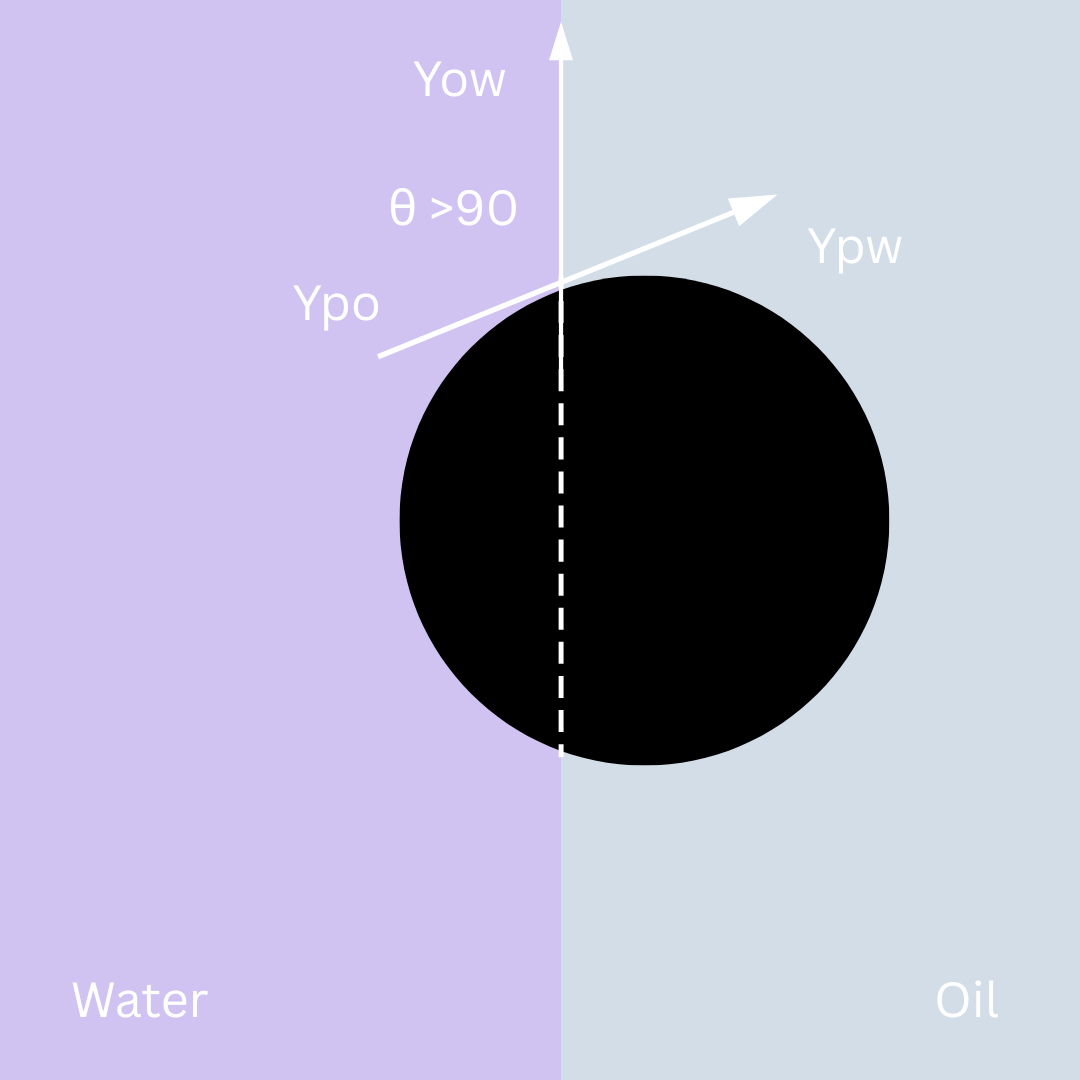
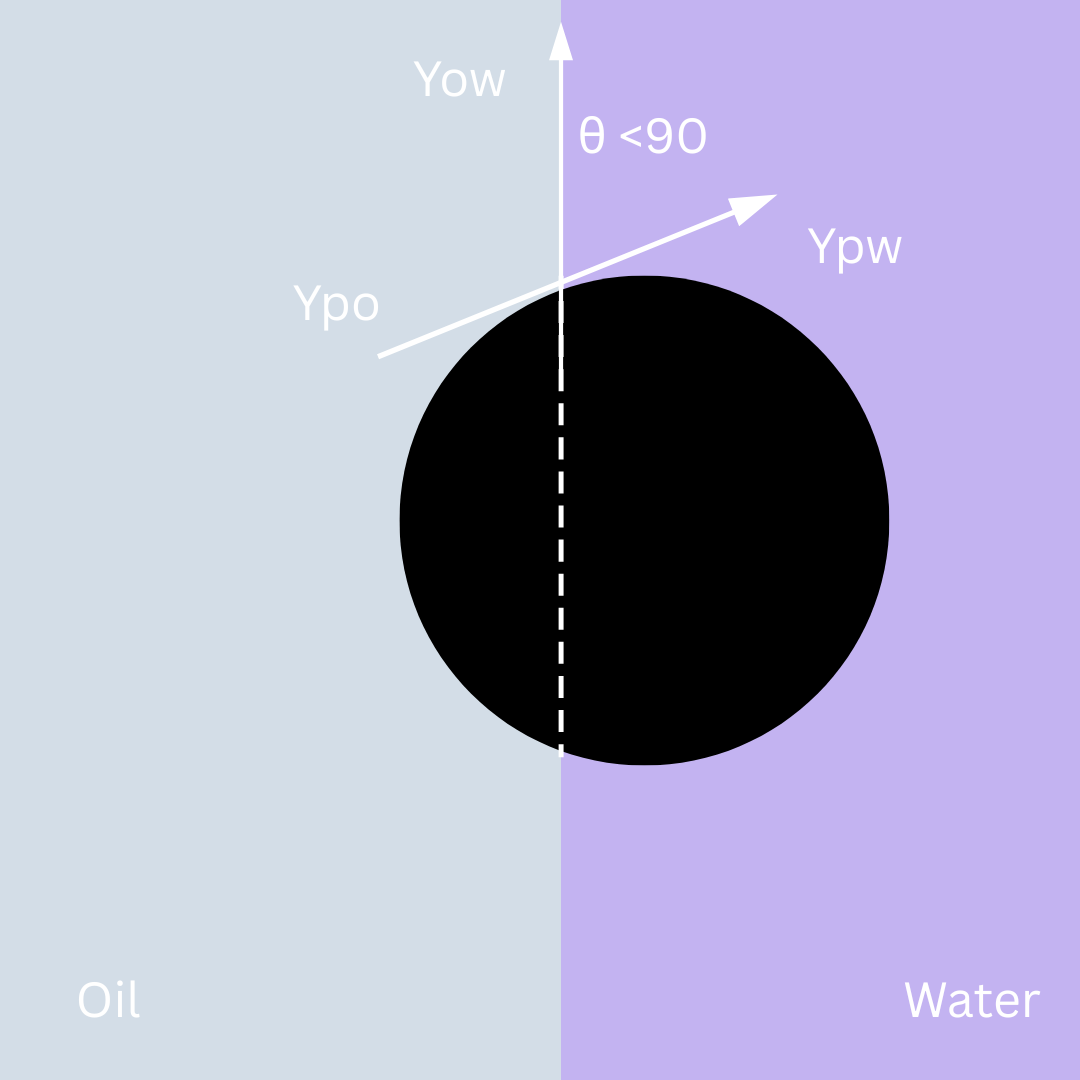
The three phase contact angle, θ, largely influences the adsorption of the particle. Theta represents the particle’s wettability and can be mathematically represented by the following equation:
cos(θ)= (γpo-γpw)/γow
(where γpo, γpw and γow are the particle-oil, particle-water and oil-water interfacial tensions)
If the particle were to only stay in one of the two phases it wouldn’t be able to stabilize the emulsion very well. Just how traditional surfactants have an oil loving and water loving component, pickering particles also have to have some affinity for both phases. This is typically achieved or improved with surface modification of the particle. We can think of θ as a similar system to HLB for non-ionic surfactants as it will help you predict what type of emulsion is likely to form.
The phase that the particle is “most wetted by” generally becomes your continuous phase. For θ<90◦, the particles are relatively hydrophilic and will be wetted to a greater extent by the water phase and will preferentially form O/W emulsions. The reverse is true for particles where θ>90◦. As a general rule of thumb, θ should be close to 90° as this is when the energy required to desorb the particle from the interface is at its maximum, meaning a particle that has a θ close to 90◦ will be the hardest to remove once anchored.
Particle Radius
The current literature suggests that the particles should be much smaller than the droplet size of the emulsion, at least one order of magnitude smaller. Now, we know from the above equation that a larger particle will be harder to remove but a balance must be struck.
While larger particles are more strongly anchored once they reach the interface, they also diffuse much more slowly through the continuous phase. During emulsification, new droplets are constantly being created, and particles must adsorb before those droplets have a chance to collide and coalesce. If adsorption occurs too slowly, droplets will merge together before they can be fully protected, leading to larger droplet sizes. For this reason, formulators are generally looking for particles that are small enough to rapidly adsorb, yet large enough to remain strongly anchored once they reach the interface.
Interfacial Tension
Just like in traditional emulsions, your oil phase components can affect the overall stability of the emulsion. According to the above equation, θ is dependent on the interfacial tensions which can be influenced by the oil. For example, the polarity of the oil may influence the particle’s affinity which will ultimately affect its ability to anchor and the type of emulsion that is formed.
Adsorption Rate
Another key consideration for stabilizing pickering emulsions is the rate of adsorption of the particles. The rate of adsorption needs to be faster than the rate of coalescence to prevent the droplets from merging together before being stabilized by the particles. Just like in traditional emulsions, limiting the droplet size is critical for ensuring stability.
This can be influenced by the manufacturing technique and the amount of shear that is being utilized during the emulsification step. Higher shear creates significantly surface area by breaking the dispersed phase into smaller droplets. While this increases opportunities for particles to adsorb, it also means particles must cover newly formed droplets more quickly. If insufficient particles are available coalescence can still occur despite the higher shear.
The surface characteristics, such as the charge of the particles, can also lead to poor stability as it introduces electrostatic repulsions that could slow the adsorption rate of the particles.
The viscosity of the oil phase can also influence the droplet size of the emulsion. A higher viscosity will cause particles to move more slowly resulting in a slower adsorption rate.
Particle Concentration
The particle concentration can influence the droplet size of the resulting emulsion. Particle concentration largely determines how much interfacial area can be covered during emulsification. If too few particles are present, droplets will continue to coalesce until the available particles are sufficient to coat the remaining interface. Increasing the particle concentration generally results in smaller droplet sizes because more interface can be rapidly stabilized.
Other Considerations
The ratio between your water and oil phases can also influence the droplet size of the emulsion. For example, the literature has shown that a larger dispersed phase will lead to a larger droplet size in most cases. Lastly, the phase in which you first disperse your particle before forming the emulsion can play a role in the type of emulsion that is obtained. Particles previously dispersed in the aqueous phase will often lead to O/W emulsions and vice versa.
By using carefully engineered particles, you can create highly stable emulsions with unique sensory properties and, in some cases, eliminate surfactants entirely. Success ultimately comes down to balancing how quickly particles reach the interface with how strongly they anchor once they arrive. By understanding concepts like particle wettability, adsorption rate, particle size, and concentration, you'll have a strong foundation for developing robust Pickering emulsions.
References
Colloidal particles as liquid dispersion stabilizer: Pickering emulsions and materials thereof
