
Formulating with Chelating Agents
What are Chelating Agents
Chelating agents bind (sequester) metal ions through multiple coordination bonds at once, forming a stable, ring-like complex. Once bound, that metal ion is essentially stopped from participating in any other reaction within solution that could lead to reduce efficacy or stability within the formulation.
Below are a few reasons why we would add a chelating agent to a formulation:
Prevent Metal-Catalyzed Oxidation
Fe/Cu catalyze radical-chain initiation which can accelerate lipid peroxidation and rancidity. This is why chelators can help boost the function of antioxidants. Read all about antioxidants here.
Reduce Precipitation Reactions
Ca²⁺/Mg²⁺ from hard water can form insoluble salts with certain anionic surfactants leading to “soap scum”
Improve Preservative Performance
Can act as a preservative booster for some preservative systems. Read all about preservatives here.
When Required for Ingredient Efficacy
Some ingredients require chelating agents to ensure efficacy over the shelf life. For example, hydrogen peroxide containing formulas need a strong chelating system since hydrogen peroxide is sensitive to iron ions.
Fe²⁺ + H₂O₂ → Fe³⁺ + •OH + OH⁻
When we Don’t Use Them
As useful as these ingredients are to formulations, there are some scenarios where we don’t want to use them.
Beneficial metal ions present
Some metal containing actives (zinc citrate, copper peptides) can lose function if their metal ion gets stripped away.
Potential ingredient interactions
Chelators often contain some ionic load so they can be incompatible with certain electrolyte sensitive polymers such as carbomers. Chelating agents are also negatively charged and could cause precipitation in the presence of some positively charged ingredients.
No metal ion source
Anhydrous formulations won’t have anything for a chelator to actually do.
W/O Emulsions
W/O emulsions often require electrolytes such as calcium chloride or magnesium sulfate within the water phase for stability. Adding a chelating agent to the water phase of a W/O will reduce the ability of these ions to impart a stabilizing benefit.
Metal Ions Found in Solution
Before we dive into how chelating agents work, I want to briefly discuss the metal ions that these ingredients bind too. When metal-containing compounds dissolve in water, the metal exists as a positively charged, freely moving ion in solution. These free metal ions surround themselves with either negatively charged ions or the partially negative end of a polar molecule present in solution. In an aqueous solution containing a metal salt, the reactive sites are typically occupied by water molecules. But if other compounds are added to the solution which interact more strongly than the water molecules, the water will be displaced. The displaced water frees up the reactive sites of the metal ion, allowing it to react with these other molecules. Sometimes these reactions can cause issues with the efficacy, stability or functionality of your formula. Chelating agents are added to formulas to prevent these issues from occurring.
The metal ions that we are typically concerned about within cosmetic formulations include the di- and tri- valent ions such as calcium, magnesium, zinc, copper, and iron. These ions can be present within a formula because of a few main sources:
Water supply
Poor water quality can carry dissolved Ca²⁺, Mg²⁺ (hard water), and trace Iron. Ion levels will vary depending on the quality of the water that is used.
Raw material impurities
Some ingredients such as clays, pigments, and calcium carbonates contain trace metals that are naturally present. Other ingredients can contain metal impurities because of their manufacturing process. Check the COA for the material to determine impurity presence.
Equipment
Metal ions, such as iron, can leach from manufacturing equipment if passivation is not routinely completed.
The ability of a chelating agent to bind to and remain as a stable complex to a given metal ion can be influenced by the metal ion’s properties.
Below are some generalized rules:
Metal charge: Higher charge (ex. Fe³⁺) increases binding strength due to stronger electrostatic attraction.
Metal size: Smaller ions (ex, Mg²⁺) can fit more tightly within the chelates “cage,” while larger ions may bind less tightly.
How do Chelating Agents Work
Chelating agents are able to work their magic because of their unique chemical structures which allow them to bind to a metal ion at multiple points. A chelator that binds with two sites is termed bidentate and those that bind with many are polydentate. In general, more binding points = a more stable, harder-to-reverse complex. For example, EDTA binds via 6 donor atoms (hexadentate) forming very strong, stable complexes. Once the metal ion is bound, the reactivity of the ion is blocked but still present within the system.
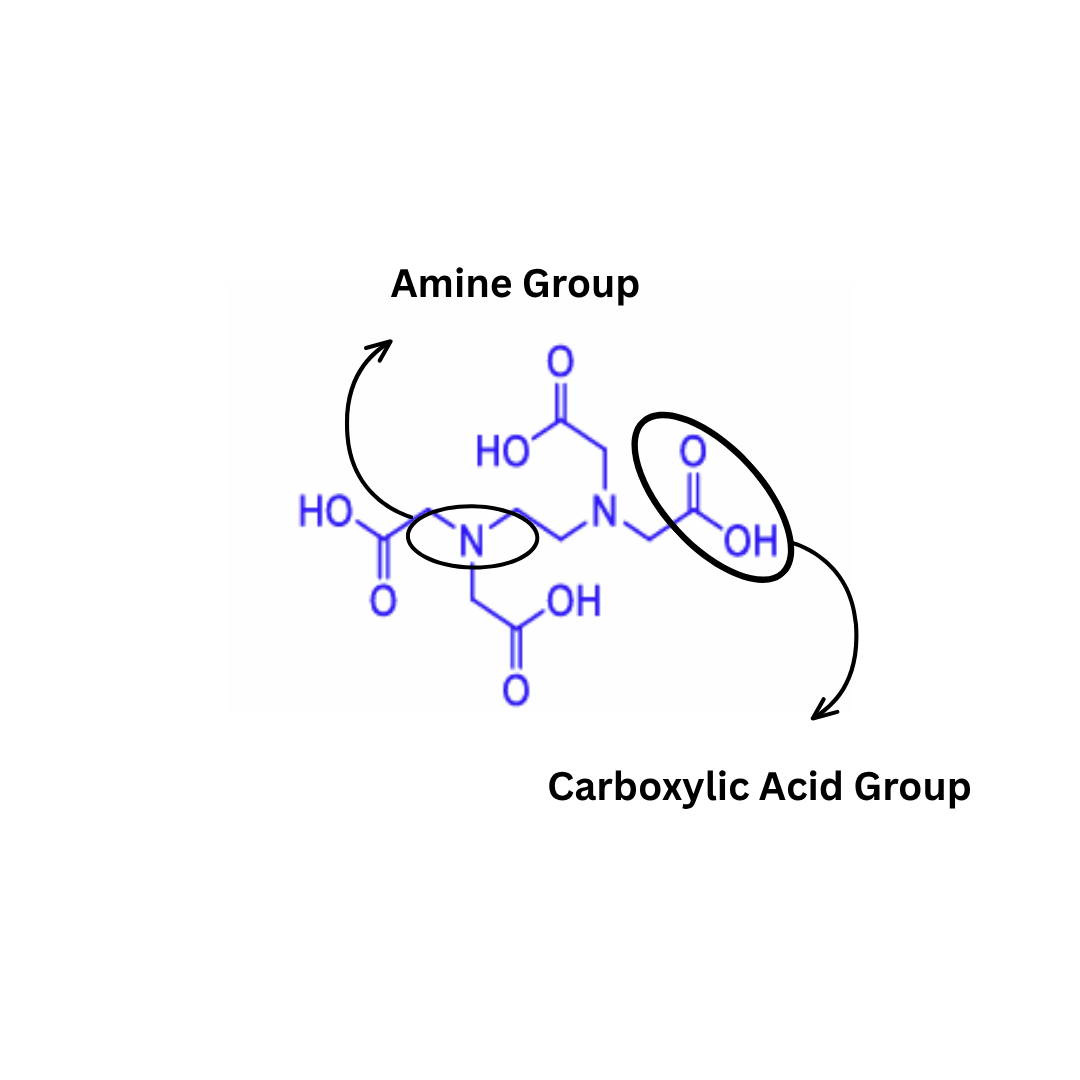
Chelators carry multiple electron-donating groups (usually carboxylate O and amine N atoms) that are involved in the binding to the metal ion. These atoms have a lone pair of electrons available to donate to the metal ion (which is electron “poor”).
A ligand that binds at only one point can fall off and reattach fairly easily but if a metal ion is held by 4 or 6 points at once, all of those bonds would have to break for the metal to be able to escape. That’s statistically much less likely, so overall the complex is far more stable. This extra stability is termed the chelate effect and is mainly due to the entropy increase that occurs in multidentate binding compared to monodentate.
Even though the complexes are very stable, we still consider the reaction of a metal ion and chelating agent to be an equilibrium type reaction. This means that un-complexed free metal ions and chelating agent will be present within the system. However, these concentrations are generally negligible. Because chelation is an equilibrium reaction, it can be described by an equilibrium constant, K [1].
Mⁿ⁺ + L ⇌ ML
Mⁿ⁺ = the metal ion (charge n+) · L= the chelating ligand
K = [ML] / ([Mⁿ⁺][L])
The equilibrium constant, K, is called the stability constant and describes the affinity a chelating agent has for any given metal ion. Because K values span many orders of magnitude across different metals, chemists work in log K for convenience. A higher log K means more of the metal is held in the chelated form and thus the complex is more stable and harder to dissociate. The affinity of the chelating agent for a particular metal ion is influenced by the charge, ionic radius, and coordination geometry of the ion.
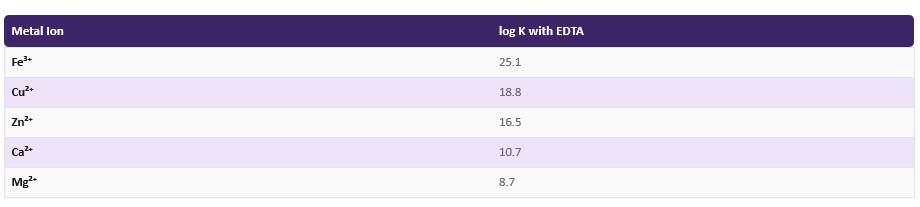
If a number of different metal ions are present in a system, the chelating agent will react with the metals in order of decreasing affinity. In general, if K is a 3-log unit difference, it will form chelate with the higher Log K ion first. For example, if Fe+3, Cu+2, and Ca+2 is present in the solution, added EDTA will complex the iron first followed by copper, once the iron is completely tied up. The calcium will be complexed only if an excess of EDTA above that required for both iron and copper is added [1].
Practical implication: if your formulation goal is controlling hard-water calcium, but trace iron is also present, that iron consumes EDTA first. Dose with this in mind, or the EDTA left over for calcium may be less than you expect.
pH Effects on Chelation
Like we mentioned above, most chelating agents use groups that are themselves acids or bases such as carboxylic acids (-COOH ⇌ -COO⁻) and amines (-N ⇌ -NH⁺). This means that the efficacy of chelation will be dependent on the pH of the solution. Whether these groups are protonated or deprotonated depends on pH, and only the deprotonated forms (carboxylate O⁻, neutral amine N) actually have the lone pairs free to donate to a metal.
Because of this, chelating agents will have an “effective pH range” where the chelation will be strongest for a given metal ion.
Low pH (acidic conditions): Carboxylic acid groups stay protonated (-COOH), so the oxygen's lone pair is tied up in the O-H bond and less available for the metal. Amine nitrogens often get protonated too (-NH⁺), which not only removes their lone pair but also creates a positive charge that electrostatically repels the metal cation.
Higher pH: As pH rises past the relevant pKa values, the acidic groups deprotonate and become available donors, and the chelator binds much more effectively.
For example, EDTA has four carboxylic acids groups and two amine groups that can participate in binding. The pH will determine how deprotonated the EDTA will be and thus the strength of its chelating ability. The primary chelating species for EDTA is the tetra-negative EDTA ion. In the tetra-negative form, all four carboxyl groups are deprotonated making the ion highly negatively charged. However, this form only dominates at high pH. At acidic pH, the EDTA is in its more protonated form giving it weaker chelating properties.
It is also important to remember that chelating strength for the different metal ions will vary with pH. As pH shifts up or down, the H+ and OH- species in solution can compete for binding with the metal. For example, at pH 7, the calcium ion is quite completely chelated with EDTA but at a pH of 5.5 and lower the H+ ion interferes and the chelation of calcium is significantly lowered.
Because pH can alter a chelating agent’s efficacy, a conditional stability constant can be determined to reflect this pH dependence. The conditional stability constant takes into consideration the interaction the metal ion may have with H+ or OH-.
General Tips for Working with Chelating Agents
Chelating agents are often highly water soluble and heat stable
Add early in the water phase so they can sequester ions before they can react with anything else in the batch
Adjust your pH accordingly. For example, if I was formulating a toothpaste that contained sodium fluoride where I was using EDTA for calcium chelation; I would purposely keep the pH in the more alkaline region to ensure good chelation and reduce any negative effects that calcium could have on the fluoride.
Typical use level is between 0.05 and 0.50 percent depending on the chelator, metal load, pH, etc. Check supplier recommendations for the specific chelator that you are using.
Considerations for Choosing the Right Chelating Agent
Target Ion(s)
Choose the chelator based off the affinity it has for the ions that you need to control. For example, in oral care we aim to chelate calcium ions to prevent tartar formation. The chelator in this scenario should have good affinity for calcium ions at the formula’s target pH.
Formula pH
Effectiveness is pH-dependent, and as we discussed most chelators need a certain pH range to stay in their active, ionized form.
Environmental Profile and Regulatory
EDTA has poor biodegradability and may need to be substituted for alternatives like GLDA or sodium phytate where necessary.
Some chelating agents may have usage restrictions in some countries. Always check with the applicable country’s regulation.
Product Positioning
Customer ingredient philosophies can dictate ingredient choices. Sodium phytate and gluconic acid derivatives are common choices for “clean” formulations.
Compatibility
Check for negative interactions with actives, preservatives, or polymers already in the formula. See “when we don’t want to use them” section above for common interactions.
Common Chelating Agents in Cosmetics
Ethylenediaminetetraacetic acid (EDTA)
EDTA salts are some of the most common chelating agents found in personal care formulations. EDTA is typically supplied as either the disodium or tetrasodium salt.
Disodium EDTA is best for formulas below pH 7
Disodium EDTA has two of the four acidic protons replaced by sodium ions and produces a mildly acidic solution which makes it the standard choice for most cosmetic formulations.
Tetrasodium EDTA is best for formula above pH 7
Tetrasodium has all four acidic protons replaced by sodium ions making it a fully neutralized salt. This gives it higher water solubility than disodium and produces a strongly alkaline solution when dissolved.
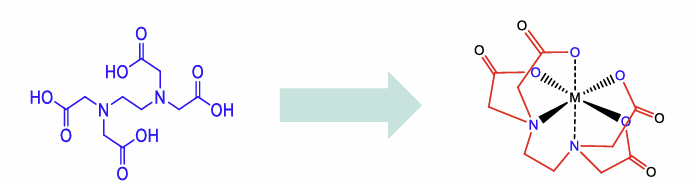
The metal complexing groups of EDTA include both the amine nitrogens and the carboxylate oxygens, taking advantage of the fact that some metals bind more strongly to nitrogen and others prefer oxygen. For the strongest complexes, all 4 carboxylate oxygens and both nitrogens should be deprotonated, however, this is not commonly achieved within personal care formulations because of the pH. Carboxylic acid pKa's are lower (~2-3), but the amine pKa's are high (~6-10), so full chelating power isn't reached until fairly alkaline pH.
pKa₁: 0
pKa₂: ~1.5
pKa₃: ~2.0
pKa₄: ~2.66
pKa₅: ~6.16
pKa₆: ~10.24
EDTA also binds to metal ions in a 1:1 mole ratio. This can allow for calculation of the amount of EDTA necessary to control any given ion.
The main drawback to using EDTA is that it is not biodegradable.
Common suppliers of EDTA chelating agents include:
Versene Line by Dow
Edeta B Line by BASF
Examples of EDTA stability constants with varying metal ions [2]:
Tetrasodium Glutamate Diacetate (GLDA)
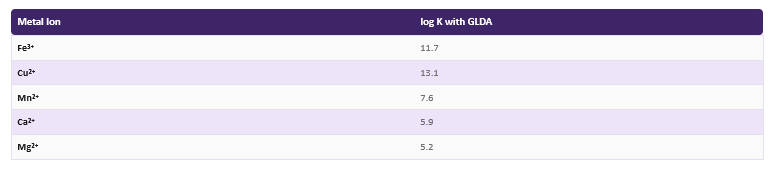
GLDA is a naturally derived chelating agent from glutamic acid that is a biodegradable alternative to EDTA. GLDA has a similar structure to EDTA, containing one less amine nitrogen, and has a similar pH dependence to EDTA. Because of one less nitrogen it can only form up to five bonds with the metal ion. This makes GLDA a slightly less effective chelating agent compared to EDTA which is evident in the Log K values below.
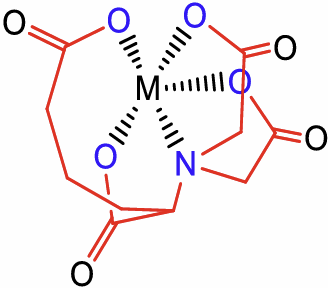
pKa₁ ≈ 2.4
pKa₂ ≈ 3.4
pKa₃ ≈ 4.6
pKa₄ ≈ 9.4
Examples of GLDA stability constants with various metals [2]:
Phytic Acid
Phytic acid is another naturally derived chelating agent that is biodegradable making it a go to pick for natural and clean beauty formulations. It is typically supplied as the acid or the sodium salt form.
Phytic acid is highly acidic and can lower the pH of a solution, while the sodium salt is very alkaline and can raise the pH. If your formula contains acidic or alkaline sensitive substances it is generally recommended to add the chelating agent first to the water phase and then add the respective substances. Likewise, you could also premix the phytic acid in a small amount of water and increase the pH prior to adding to the main batch.
The metal complexing groups of phytic acid include oxygen. Unlike EDTA and GLDA, Phytic acid contains six phosphate groups, each capable of donating oxygen atoms to metal ions. The number of bonds formed with the metal ion is not as straightforward and will depend on the species, pH and stoichiometry.
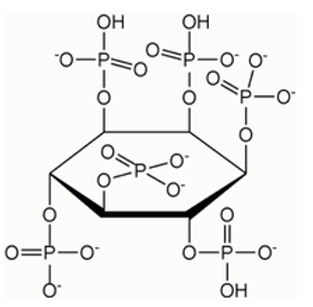
Phytic acid’s effectiveness is also dependent on the pH of the solution. This chelating agent will have higher efficacy around pH 6 or higher.
pKa1 ≈ 1.9
pKa2 ≈ 2.5
pKa3 ≈ 4.0
pKa4 ≈ 5.5
pKa5 ≈ 6.5
pKa6 ≈ 9.5
The stoichiometry of phytic acid is often not as clean as EDTA and may participate in the binding of multiple metal ions within one phytic acid molecule.
Common suppliers of phytic acid chelating agents include:
Dermofeel PA and Dermofeel PA-12 by Evonik
GreenGard PA12 by Green Line
Etidronic Acid
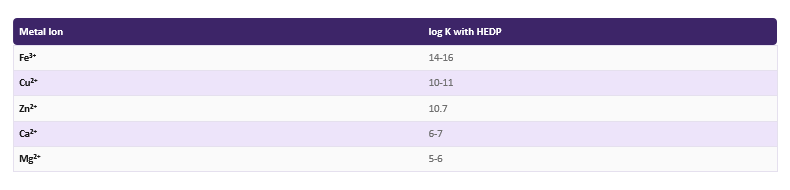
Etidronic acid, also known as 1-hydroxyethylidene-1,1-diphosphoic acid (HEDP), is an organophosphonic acid. It can bind to the metal ion via one oxygen from each phosponate group and in some cases with hydroxyl oxygen. This chelator forms at least two bonds which is evident in the lower log K values compared to EDTA.
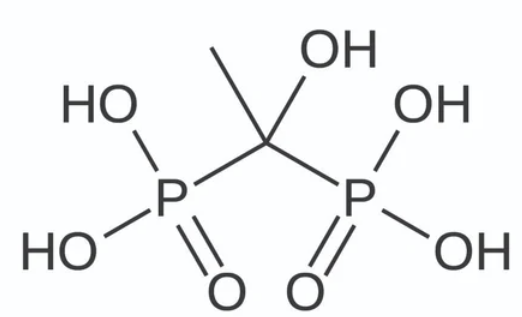
Just like the other chelating agents, the pH will determine how many of the -OH groups are depronated and available for binding, dictated by the pKa:
pKa₁ ≈ 1.35
pKa₂ ≈ 2.87
pKa₃ ≈ 7.03
pKa₄ ≈ 11.3
Examples of Log K values for HEDP with various metals [3]:
Chelating agents are a small but an essential piece to most formulations. By binding metal ions like Ca²⁺, Fe³⁺, and Cu²⁺ before they can catalyze oxidation, cause precipitation, or interfere with actives, they help protect the stability, efficacy, and shelf life of a formula. Choosing the right one comes down to matching the chelator's chemistry and its affinity for your target ion, and its compatibility with the rest of your formula.
References:
[1] Chelation Chemistry: General Concepts of the Chemistry of Chelation
[2] Chelating capacity and stability – Green-Mountain Chem
[3] The Chelation Power of HEDP: A Comparative Analysis for Scientific Applications
[4] An In-depth Technical Guide to the pKa Values of Edetate Trisodium for Pharmaceutical Scientists
