
Controlling Oxidation in Cosmetic Formulations
The degradation of an ingredient(s) via oxidation is common and can affect the stability and overall efficacy of a formulation. In this article we dive into oxidation and what we can do to reduce its effects in a formula.
Oxidation is a reaction where a substrate loses an electron. This reaction is typically carried out by oxygen or another oxidizing ingredient and can result in a structural change of the substrate. This structural change can affect the quality, potency and safety of the formulation. It can be kickstarted from exposure to UV light, high heat or mechanical stress in the presence of oxygen.
What Makes a Chemical Structure Prone to Oxidation
The single biggest predictor is degree of unsaturation or the number of carbon–carbon double bonds (C=C). The vulnerable point isn’t the double bond itself, but the C–H bonds allylic (adjacent) to it, and especially the bis-allylic positions which are the carbons sitting between two double bonds. These bonds are unusually weak because the radical left behind after losing a hydrogen atom is resonance-stabilized across the neighboring double bond system, making that hydrogen far easier to remove than an ordinary C–H bond. More double bonds means more bis-allylic positions, which typically means faster oxidation. This is why polyunsaturated oils (ex. linoleic/linolenic-rich) oxidize far faster than monounsaturated ones (ex. oleic), which are in turn considerably less stable than fully saturated oils and butters.
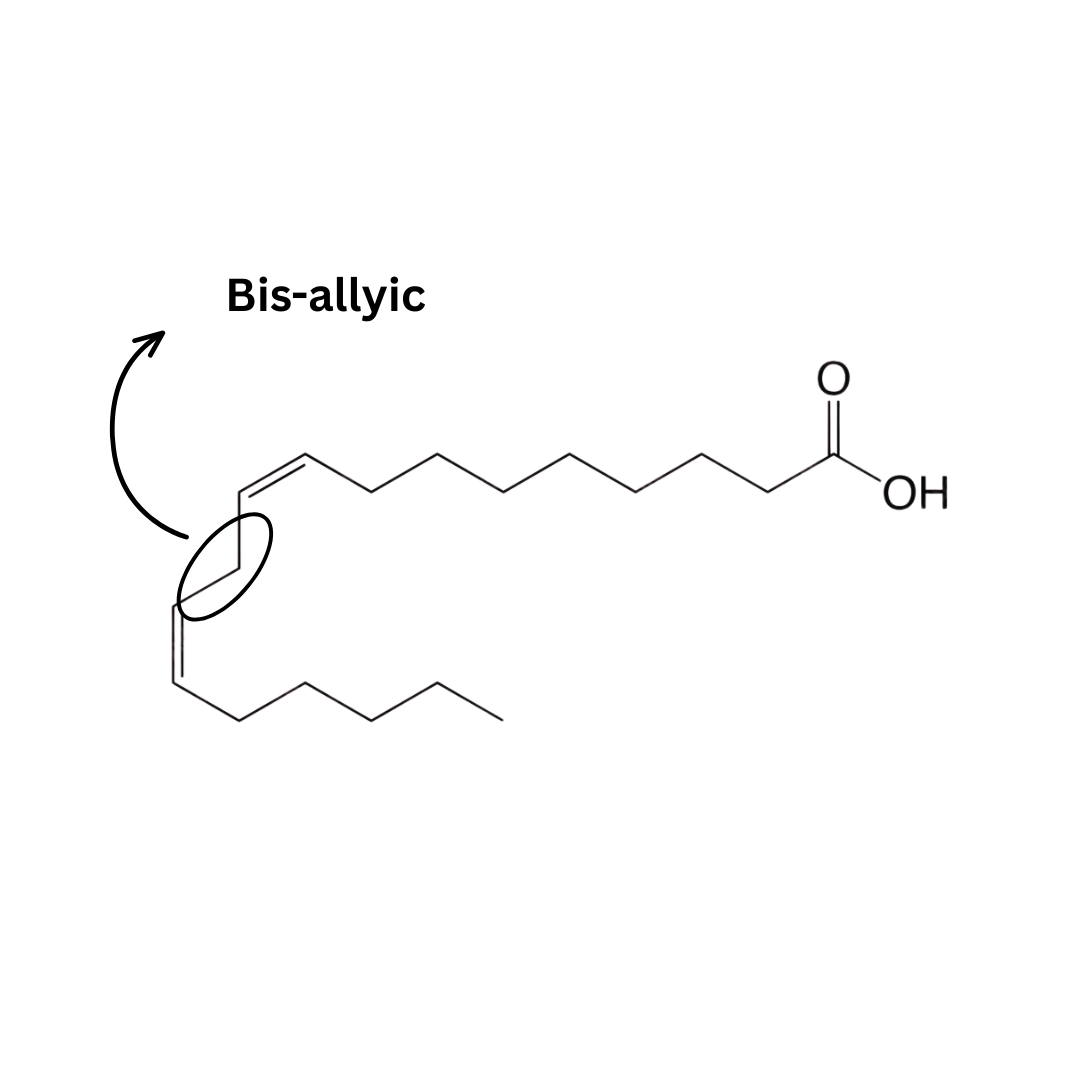
The iodine value can help you predict oxidation risk of an ingredient such as a plant oil. The iodine value is the mass of iodine that reacts with the double bonds in 100 g of a fat/oil. It is a quantitative measure of the degree of unsaturation.
Higher IV = more double bonds = generally more oxidation-prone.
Oxidation Mechanisms
The following are known mechanisms for oxidative degradation:
Autoxidation
Nucleophilic/electrophilic
Oxidation that is mediated by single electron to dioxygen
Autoxidation is the most common type of mechanism that can affect the chemical substances we use in formulation, followed by the nucleophilic/electrophilic mechanism [1].
Autoxidation
Autoxidation is a chain process where the oxidization of one substrate molecule can oxidize an additional substrate molecule which can oxidize another substrate molecule and so on and so forth. I am sure you can start to see that if left unchecked, this can be a disastrous scenario.
Initiation
In order for autooxidation to occur, one substrate molecule has to lose an electron. This is typically carried out by a hydroperoxide radical that has formed from impurities within the formula (we will touch more on this in the next section). The abstraction of the hydrogen from the substrate results in a radical form of that substrate molecule (D•) [1].
Propagation
In the next phase, the substrate radical can react with O₂ present within the formula. This produces a substrate derived peroxy radical (DOO•) which can now go on to abstract a hydrogen from a different substrate molecule. The reaction of the peroxy radical with another substrate molecule is the rate limiting step in this process and can lead to an accumulation of the peroxy radicals. However, this chain event can result in the production of hundreds of hydroperoxide molecules (DOOH) from a single initial radical [1]. The formation of the hydroperoxide can be measured and identified as it is relatively stable.
D• + O₂ → DOO•
DOO• + DH → DOOH + D•
Termination
In order for the reaction to stop, two radicals must combine to form a stable product. This can occur when the substrate concentration has been reduced to the point where the peroxy radicals begin to react with each other. When this occurs, they form a non-radical product. In this reaction two peroxy radicals can react and decompose into an alcohol and a carbonyl [1]. This is the stage where antioxidants typically intervene to prematurely stop the propagation reaction from occurring.
Nucleophilic/electrophilic
Some chemical substances can also react with hydrogen peroxide, that is present as an impurity within a formulation. These reactions are much slower and can occur across the shelf life of a product. Hydrogen peroxide can react with secondary and tertiary amines, thioethers and olefins [1]. If the chemical substance is in its protonated state, the reaction will be much slower. So of course, when dealing with an oxidation prone substance that is a weak acid or weak base, the pH of the formula will matter.
Formulation Impurities that can Initiate Oxidation
In the previous section, we said that the initial abstraction of a hydrogen from the substrate molecule is typically carried out by a hydroperoxide radical that is present within the formula. So, now the question is what are peroxides and where do they come from?
We can broadly classify peroxides into organoperoxides and hydroperoxides. Organoperoxides have two “R” groups (ROOR’) which could be a number of different functional groups. When one of the R groups is an -OH group we call that a hydroperoxide. Peroxides can easily form radicals because their O-O bond is very weak. This means that it can easily be split to form a hydroxyl (•OH) or alkoxy radical (RO•) [1]. Radicals are very reactive and have the ability to abstract a H atom from susceptible substrates.
Now, what breaks the O-O bond? Well, it could be a variety of culprits including heat, UV light, metal ion catalysts, pH or a reducing agent present within the formula. Trace metal ions are of particular interest because they are almost always present as impurities within formulations. You may have heard of Fenton-like reactions, where a transition metal such as Fe(III) or Fe(II) reacts with hydrogen peroxide to produce radicals:
Fe(II) + HOOH —> Fe(III) + •OH +OH-
Fe(III) + HOOH —> Fe(II) + •OOH + H+
Peroxides can be found as impurities in a variety of commonly used excipients such as polyethylene glycol, PVP, cellulose gums and polysorbates. In the production of these ingredients peroxides are used to initiate the polymerization reaction which results in trace levels remaining [1].
Oxidation Control Strategies
When you are formulating with an oxidation prone ingredient, it is important to control the oxidation and prevent it from causing significant quality issues over the shelf life. Below are common strategies that are often used together to reduce oxidation of a cosmetic formulation.
Raw material control
One of the obvious control strategies is to monitor peroxide levels within susceptible raw materials or when possible swap to a different ingredient that doesn’t have peroxide contamination issues. Keep in mind that storage conditions can affect the peroxide concentration over time. For example, studies have found that high temperatures combined with lower humidity increased peroxide levels in PVP during storage [1].
Determination of the peroxide value is one way that the extent of oxidation within a raw material can be monitored. It is determined by measuring the amount of iodine which is formed from the reaction with peroxides that are present within the material.
Oxygen control
In autooxidation, oxygen is required in the propagation step and thus controlling oxygen is a useful strategy in reducing oxidation. Manufacturing under an inert gas, such as nitrogen, is a common for products that contain retinol. Being careful not to introduce too much air into the formula during mixing can also help reduce oxygen levels to some degree. Reducing the amount of headspace within the packaging and utilizing packaging that has lower oxygen permeability are two other useful strategies. Oxygen scavengers such as sodium metabisulfite can also be added to a formulation to effectively remove dissolved oxygen from solution.
Chelating Agents
The use of chelating agents within the formula can help reduce the amount of free iron and copper available within solution that can react with peroxides. Read all about chelating agents here.
Antioxidants
Antioxidants are ingredients that can prevent or slow the oxidation of other molecules and are commonly used within formulations that contain susceptible substrates. Most antioxidants work by terminating the peroxy radicals, sometimes called chain-breaking. We mentioned earlier that the reaction of the peroxy radical with another substrate molecule is the rate limiting step in the propagation process. In order to be an effective antioxidant, it must react faster with the peroxy radicals compared to the substrate molecule [3].
Antioxidants donate a hydrogen atom to the radical, converting the radical to a stable, non-reactive species while simultaneously becoming a radical themselves. The key to stopping the propagation reaction is in the fact that the antioxidant radical is stable and non-reactive.
For example, the antioxidant BHT will donate a hydrogen atom from its phenolic -OH group to the peroxy radical converting it to a hydroperoxide (ROOH). The resulting BHT peroxy radical (ArO•) is stable.
ROO• + ArOH → ROOH + ArO•
The most commonly used antioxidants are phenolic compounds, meaning they have at least one -OH group bonded to an aromatic ring. The -OH groups are the functional groups that will donate the hydrogen, however, -NH or -SH groups can also donate hydrogens. Depending on the antioxidant, there may be multiple groups within one molecule that can donate a hydrogen atom. One of the key characteristics of a good antioxidant is that the hydrogen is relatively easily to abstract which can be described by the bond dissociation energy or BDE [3]. The BDE of the -OH can be increased or decreased because of other functional groups attached to the ring. For example, research has found that having electron withdrawing groups (ex. CN, CHO, COOR) in certain positions on the ring can increase the BDE of the -OH bond, making it harder to abstract [3].
Another key requirement for an effective antioxidant is that the radical that is formed should be relatively non-reactive. Otherwise, the antioxidant could continue the propagation reaction. One of the reasons that antioxidants tend to be phenolic compounds is because of the aromatic ring. When the -OH group donates the hydrogen atom, it leaves behind an unpaired electron. Typically, that unpaired electron is very reactive, however, in an aromatic structure, the unpaired electron can spread out across the ring which makes it more stable and less reactive.
Some antioxidants such as BHT and BHA also utilize steric hindrance to reduce the reactivity of the radical. These molecules contain bulky ortho tert-butyl groups that restrict the oxygen radical from participating in further reactions [3].
Phenolic antioxidants can be reduced by protic solvents or solvents that can participate in hydrogen bonding. This is thought to be because the -OH group in the antioxidant can participate in H-bonding with the solvent. This makes the -OH less reactive and less likely to react with the peroxy radical.
Commonly used antioxidants in cosmetics include tocopherol, BHA, BHT, ascorbic acid, propyl gallate and rosemary extract.
Tocopherol
Tocopherol is an oil soluble antioxidant that is commonly used in cosmetic formulas. It has four isomers (or spatial arrangements): alpha, beta, gamma and delta. Alpha-tocopherol is commonly used but can act as a pro-oxidant, especially at higher levels. Studies have shown that gamma and delta are often stronger antioxidants for formula production over alpha tocopherol. You can also buy a blend of all the isomers called “mixed tocopherols".” If you see the word “d” in front of the isomer (ex. d-alpha) that is the natural version whereas “dl” dictates a synthetic version.
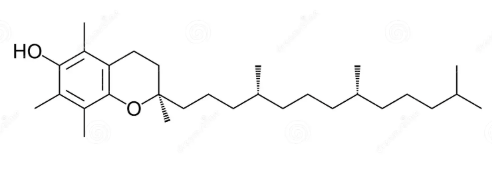
Tocopherol is typically used from 0.05-1.0% and should be added to the cool down phase, below 40C. It is important to remember that most tocopherols come as dilutions that contain a certain level of tocopherols (typically 50 or 70%) in an oil such as sunflower or soy.
Tocopherol can donate up to two hydrogen atoms. The first comes from the phenolic -OH group. The second hydrogen abstraction can lead to an irreversible breaking of the chromanol ring. The radical formed from the first hydrogen can be regenerated by another antioxidant such as Vitamin C, which can keep the individual tocopherol molecules functioning longer [3]. This is why you sometimes see these two ingredients used together in formulations.
BHA/BHT
Butylated hydroxyanisole (BHA) and Butylated hydroxytoluene (BHT) are commonly used in food oils, fragrances and cosmetic formulations. They are fully synthetic antioxidants and like tocopherol, are oil soluble. For the purposes of cosmetic formulation, they are both heat stable with BHA being more so than BHT. Even so, BHT can withstand up to 100C.
BHA and BHT are very similar structurally, but BHT is more sterically hindered thanks to the second tert-butyl group. BHA can exist as two isomers, with the 2-tert-butyl-4 methoxy phenol isomer generally being more effective [3].
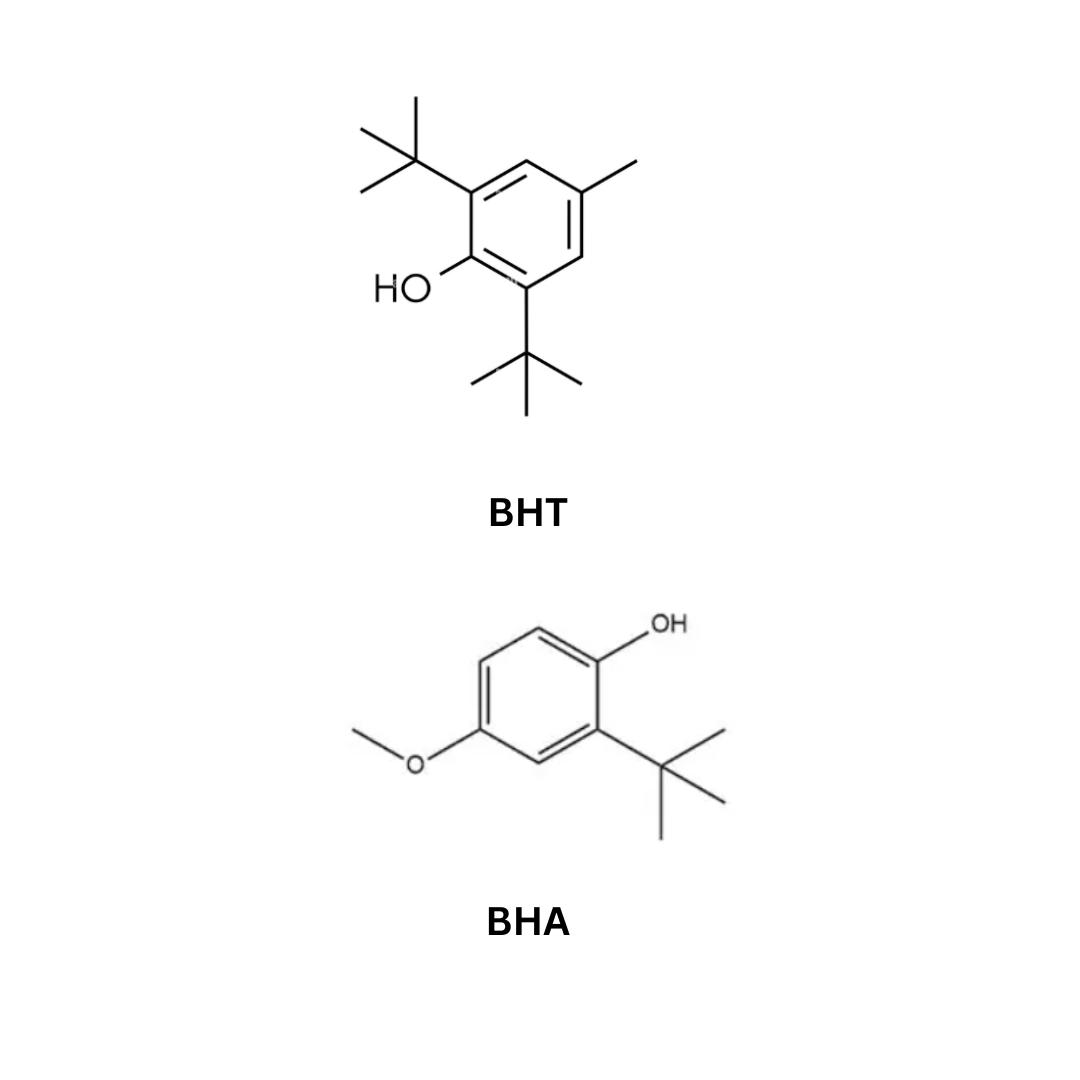
BHT is restricted in the EU up to 0.8% max in rinse-off and leave on formulations.
One last note I want to make is that there is not a one size fits all concentration for antioxidants. The usage level will depend on your individual formula. Finding the right level will ultimately come down to testing different antioxidant concentrations in conjunction with other control strategies.
References
[1] Oxidation of Drugs during Drug Product Development: Problems and Solutions - PMC
[2] Using BHT to inhibit oxidation in chemical reactions
[3] Understanding the chemistry behind the antioxidant activities of butylated hydroxytoluene (BHT): A review
